
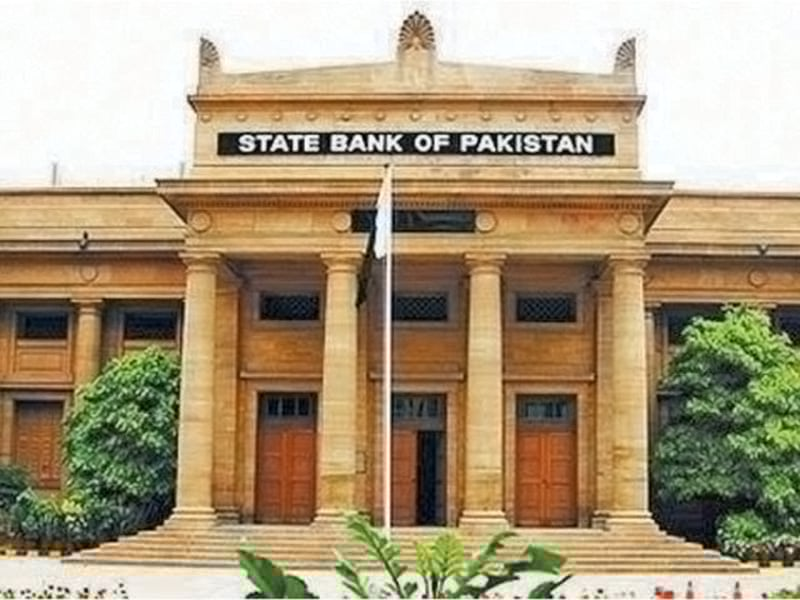
Business leaders have called for a 6% cut (600 basis points) in the interest rate in one go to accelerate economic growth and business activities in the country.
Most analysts predict a seventh consecutive rate cut by the State Bank of Pakistan (SBP) on Monday, amid the first International Monetary Fund (IMF) review of 7 billion USD bailout package. However the current interest rate stands at 12%, while inflation is declining, according to government claims. The State Bank of Pakistan (SBP)’s Monetary Policy Committee (MPC) is scheduled to meet on March 10 to review the interest rate.
The country could unlock a further tranche of funding if the IMF review is approved before the budget is unveiled in June, as it pursues economic reforms and reforms are mandated by the IMF programme.
Meanwhile, the Business leaders are demanding that the government must reduce interest rates to 6% immediately for the next five years and introduce an amnesty scheme to rejuvenate the construction industry. They also urged the introduction of attractive loan schemes to support struggling Small and Medium-sized Enterprises (SMEs). They added that the attractive loan schemes terms and conditions should be easy as the small enterprises can easily get it.
Renowned industrialist and exporter from Balochistan, Ismail Suttar, stated, “The best parameter for interest rate decrease or increase is to keep a close eye on inflation over the past three months. Inflation in Pakistan has been at its lowest, so why have we not adjusted the interest rate accordingly? Are we being overly cautious, or do we not want our economy to grow? If we are being cautious, we should still reduce rates by at least 150 to 200 basis points in one go so that the economy can respond positively.”
Furthermore, the president of (FBATI) Federal B Area Association of Trade and Industry, Karachi Shaikh Muhammad Tehseen urged the SBP to lower the policy rate to a single digit on a long-term basis to encourage industries to utilise financing from commercial banks.
The central bank’s easing cycle, one of the most fast emerging markets, follows a series of rate cuts totalling 1,000 basis points (bps) over six months, which took the key rate to 12 per cent, down from a record high of 22pc in June. Moreover, the latest cut in policy rate of 100 bps, was in January 2025.
In Pakistan, inflation is at a nine-year low in the country. “According to the government’s own statistics, inflation stood at 1.5% in February 2025 and 2.4% in January. But policy rate remains at 12%, reflecting a premium of 1,050 basis points compared to core inflation,” he said. Moreover, Pakistan’s cost of doing business, ease of doing business, and access to finance are at the lowest levels compared to its competitors in export markets.
A Reuters survey of 14 analysts suggests that the central bank may further reduce rates, with a median forecast for a cut of 50 bps.
Of the 10 analysts expecting a rate cut, three estimated its size at 100 bps, one at 75 bps, and six at 50 bps. The rest saw no change.
Most analysts expecting a rate cut believe the SBP will stop when rates hit 10.5pc to 11pc, due to a potential rise in inflation. They anticipate a moderate rise from March to May.
Analysts expecting Inflation will “bottom out” in the year’s first quarter before gradually rising, said Ahmad Mobeen, senior economist of S&P Global, who anticipates average inflation of 6.1pc for 2025.
Fortunately, downward trend in inflationary pressures has continued for the past several months. The only viable and genuine solution to get back on an economic growth trajectory is to support industry and exports. these targets was only possible if industrial activity picked up and agricultural output improved.