
The Pakistan Space and Upper Atmosphere Research Commission (Suparco) on Monday forecasted that the holy month of Ramazan would begin on March 2 (Sunday) while Eidul Fitr would be observed on the 31st of the month.
The commission said that the probability of the moon’s visibility on Feb 28 was “not visible even with optical aid” and thus the likelihood of a moon sighting on the date in Pakistan is “extremely low”.
“Consequently, Sha’aban is expected to complete 30 days, and the first day of fasting will likely be observed on March 2. In Saudi Arabia, the new moon is also expected to be born on Feb 28. However, due to the moon’s position relative to the horizon, and atmospheric clarity, the crescent is expected to be visible leading to the commencement of Ramzan on March 1. In Pakistan, however, it will begin a day later.
However, if the moon is not visible, the holy month will begin on Sunday, March 2, 2025.
The conclusion of Ramadan marks the arrival of Eid ul-Fitr, which is anticipated to be observed on Sunday, March 30, or Monday, March 31, 2025, depending on moon sightings.
According to astronomical models, the Shawwal moon will be visible on March 30, indicating that Eidul Fitr will likely be observed on March 31 in Pakistan.
However, In the United states Ramadan will likely begin on the evening of February 28, 2025, with the first fast observed on March 1, 2025.
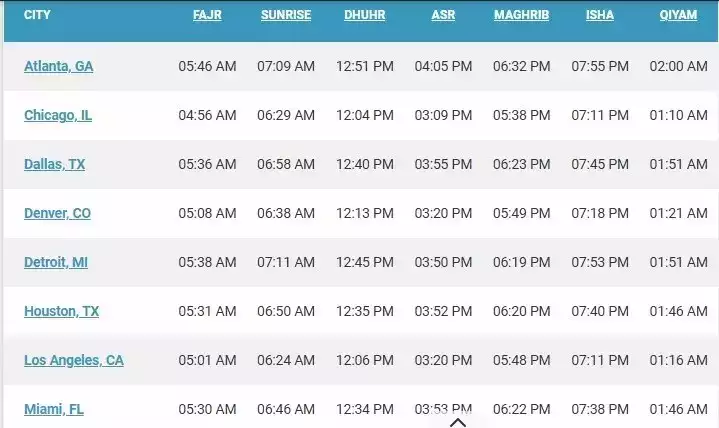
According to IslamicFinder, Sehri and Iftar timings for various U.S. cities will be adjusted daily based on the Islamic calendar.
Here’s a tentative schedule for Ramadan Sehri and Iftar timings as per the Islamic Finder (subject to location and local moon sighting:
Moreover, the Supreme Court of Saudi Arabia, along with other global moon sighting committees, has urged believers to look for the new moon on Friday, February 28, 2025 (corresponding to 29 Sha’ban 1446 AH in the Islamic calendar).
If the moon is sighted on that evening, Ramadan 2025 will commence on Saturday, March 1, 2025, and conclude on Saturday, March 29, 2025.